A partner you can trust
Choosing reliable suppliers requires more than comparing prices or polished product photos. The right Harsha Solar Cleaning Brush should protect glass, remove dust, and support consistent maintenance across demanding solar sites. Supplier quality also affects worker efficiency, transport costs, and long-term panel care.
Solar O&M educator Sean White has stated, “Good solar maintenance depends on careful work, appropriate tools, and consistent inspection.” This practical view guides our comparison of leading worldwide suppliers. We examine brush-fiber softness, pole strength, water-flow control, replacement parts, packaging, and technical support. These details matter. A soft brush head can reduce scratching risks, while rigid telescopic poles help technicians reach wide rooftop arrays. Suppliers should also provide clear specifications, usage guidance, warranty terms, and responsive after-sales service.
Real-world experience remains important. A supplier may present impressive test data, yet field conditions can expose weak joints, clogged channels, or uncomfortable grips. No supplier is perfect. Some performance differences are also difficult to measure without repeated testing across dust, heat, humidity, and water-quality conditions. Buyers should request samples and inspect them under practical cleaning routines. Evidence matters more than promises.
This guide introduces top Harsha Solar Cleaning Brush suppliers worldwide through a careful, transparent lens. It considers manufacturing consistency, product durability, customer feedback, delivery capability, and responsible business practices. The goal is not to promote one seller blindly. It is to help solar operators identify suitable tools for safer, cleaner, and more efficient panel maintenance.
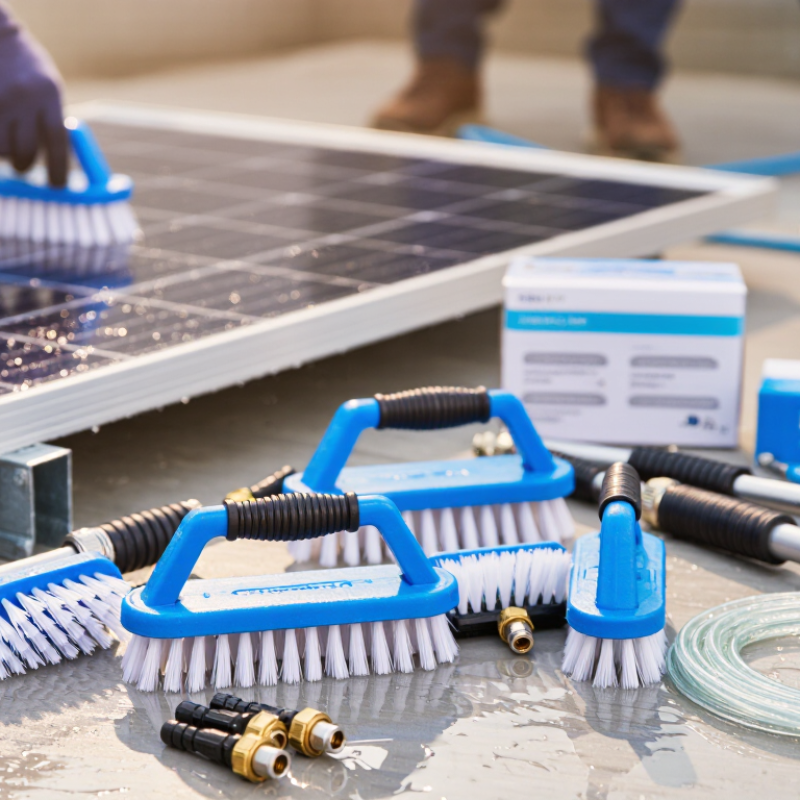
Solar cleaning brushes are designed to remove dust, pollen, bird residue, and light mineral deposits from photovoltaic modules. Their purpose is simple: protect light absorption without scratching the glass surface. Soft, non-abrasive bristles are essential. A rigid brush can create micro-scratches, especially when sand sits between the bristles and panel.
The IEA PVPS Task 13 soiling-loss report estimates average global energy losses near 3–4%, with much higher losses in dry and dusty regions. That figure explains why regular cleaning matters for rooftop, commercial, agricultural, and utility-scale systems. Effective brushes usually combine dense nylon bristles, a lightweight telescopic pole, and a water-fed design. Some models use rotating heads for faster coverage. Low-pressure rinsing is safer than aggressive spraying.
Small details matter. A practical brush should feel balanced at full extension. It should not shed bristles. It should also allow operators to work from the ground, reducing ladder use and accidental contact with modules. Cleaning frequency depends on rainfall, nearby construction, pollen, and tilt angle. Monthly cleaning may help one site, but waste water at another. That judgment cannot come from a product label alone. Operators should inspect one panel first, record power output, and compare results after cleaning. The process is not perfect; hard-water stains may need specialist treatment, and careless washing can leave more residue than it removes.
When evaluating solar cleaning brush suppliers, examine the brush head before discussing prices. Experienced suppliers should explain bristle softness, water resistance, and compatibility with coated panels. Hard bristles can create fine scratches. That risk matters.
Request a sample and test it on a dusty panel. Check whether the bristles hold their shape after repeated wet cleaning. Test the handle joints, hose connection, and water flow under ordinary pressure. A reliable supplier provides clear material specifications, inspection records, and replacement-part availability. Details matter. Ask for production lead times, packaging standards, and shipment tracking. These details reveal operational discipline better than polished sales language.
Technical support also deserves close attention. Suppliers should offer practical cleaning guidance, safe handling instructions, and responsive answers from trained staff. Look for documented quality procedures rather than vague promises. Independent customer references can help confirm delivery consistency and after-sales service. Warranty terms must state coverage periods, exclusions, and response times in plain language. Very low quotations deserve careful review, especially when spare parts or testing are missing. Test it wet. A supplier may appear professional yet overlook small connector failures. I have seen minor leaks stop a full workday. That gap matters. Allow room for honest uncertainty, and record test results before approving larger orders.
This neutral procurement benchmark prioritizes cleaning effectiveness, brush durability, panel-safe materials, water efficiency, delivery capability, and after-sales support. The percentage values represent recommended evaluation weights for comparing solar cleaning brush suppliers without using company or brand-specific data.
Solar cleaning brush suppliers vary significantly by global market region. North American suppliers often focus on telescopic systems, low-water cleaning, and detailed product documentation. Buyers should request bristle hardness data, pole strength tests, and replacement-head availability. Field experience matters here, especially for large rooftop arrays exposed to dust, snow, and bird residue.
European suppliers commonly emphasize ergonomic design, reduced water consumption, and traceable manufacturing records. Their regional distributors may provide training, spare parts, and maintenance guidance.
In Asia-Pacific, suppliers often compete through flexible production, practical pricing, and customized brush widths. However, specifications can differ between batches. A sample inspection is sensible before placing a large order. Small details matter.
Middle Eastern and African suppliers usually prioritize heat resistance, compact storage, and performance in dry, sandy conditions. Latin American distributors may offer stronger local support when imported equipment faces shipping delays.
Buyers should compare delivery times, warranty terms, handle length, and cleaning performance on real panels. I would not choose a supplier from price alone.
A cheap brush can leave fine scratches, shed bristles, or require frequent replacement. Even experienced purchasers can overlook water hardness and abrasive dust. Regional service quality is sometimes less consistent than product quality.
Solar cleaning brush procurement now deserves engineering-level scrutiny. IEA PVPS Trends 2024 reports 456 GW of new photovoltaic capacity in 2023, lifting global capacity above 1.4 TW. That scale makes maintenance choices financially visible. IEA PVPS Task 13 reports typical soiling losses near 3–4% annually, although local conditions vary sharply. Suppliers should provide abrasion-test results, bristle specifications, water-flow controls, and field references from dusty climates.
Quality is only one comparison point. A low quotation may exclude replacement heads, freight, spare poles, or operator training. Compare the landed cost over three years, not the catalogue price. Practical trials matter. Check whether the brush removes bird residue without scratching coated glass. I would request a controlled sample test before any large order. Some suppliers promise similar results, but their handle stiffness and bristle density can differ noticeably.
Customization should cover pole length, connector design, brush width, and water-fed options. Ask about minimum order quantities and sample approval timelines. Reliable suppliers provide drawings, cleaning instructions, warranty terms, and documented response times. Support is often overlooked. It should not be. The best evaluation records cleaning speed, water use, surface marks, and worker fatigue across several panel types. No supplier gets every detail right; buyers should keep testing instead of trusting polished specifications.
How to Select the Right Solar Cleaning Brush Supplier
A reliable supplier should understand solar maintenance, not only sell brushes. IEA PVPS Task 13 reports average soiling losses of about 3–4% annually. Dry regions can exceed 10%. That makes cleaning quality a financial concern, not a cosmetic detail. Ask suppliers for field results, bristle specifications, and testing methods. A soft, non-abrasive brush is usually safer for glass surfaces and protective coatings. However, “soft” has no universal definition. Request a sample and inspect the bristles under bright light.
Supplier experience matters during real cleaning work. The handle should reach panel rows without excessive bending. The brush should remain balanced when wet. Check whether replacement heads, poles, and connectors are available locally. NREL guidance on photovoltaic operations emphasizes reducing damage, water waste, and unnecessary downtime. A supplier that cannot explain these risks may lack practical knowledge. Ask how the brush performs with dry dust, bird deposits, and fine sand.
Do not trust impressive claims alone. Compare two or three samples on the same panel section. Measure cleaning time, visible residue, and water consumption. A simple test often reveals more than a polished brochure. Verify warranty terms, batch consistency, and delivery records. No supplier is perfect. I would still document every trial, because one overlooked connector or brittle bristle can create an expensive maintenance problem.
| Evaluation Dimension | Recommended Benchmark | Why It Matters | Documents or Evidence to Request | Priority |
|---|---|---|---|---|
| Supplier Experience | At least 3 years of experience in solar-panel cleaning equipment or related industrial brushes | Experienced suppliers are more likely to understand panel coatings, delicate surfaces, logistics, and field maintenance requirements. | Company profile, product history, project references, and export records with sensitive details removed | High |
| Brush Material | Soft, non-abrasive bristles suitable for photovoltaic glass; common options include nylon or flagged synthetic fibers | Bristle hardness, shape, and contamination control affect the risk of scratching or leaving residue on module surfaces. | Material specification, bristle hardness information, sample brush, and panel-surface compatibility test | High |
| Brush Width | Approximately 30–100 cm, selected according to panel layout and operator capacity | A wider head can improve productivity, while a narrower head is easier to control around frames, gaps, and restricted areas. | Dimensional drawing, working-width tolerance, replacement-head dimensions, and product photographs | Medium |
| Pole Reach | Common telescopic configurations range from about 3 m to 12 m; larger systems may require specialist handling | The correct reach reduces ladder use and improves access to roof-mounted or elevated arrays. | Collapsed and extended lengths, pole material, locking method, weight, and safe-use instructions | Medium |
| Water System Compatibility | Compatibility with purified-water systems, hose connections, and the buyer’s operating pressure range | De-ionized or low-mineral water can reduce spotting, but the brush must match the available pump, hose, and connector system. | Inlet size, recommended flow and pressure, connector standards, hose routing, and water-use instructions | High |
| Cleaning Productivity | Supplier must provide a measured area-per-hour result under defined conditions rather than an unsupported headline claim | Actual output depends on dirt type, panel angle, water quality, operator skill, weather, and equipment setup. | Standardized test method, panel area cleaned, soil condition, water consumption, and operator count | High |
| Product Safety | Clear instructions for electrical safety, wet-area operation, slip prevention, and work-at-height procedures | Solar arrays may remain electrically energized in daylight, and wet cleaning introduces additional slip and equipment risks. | Risk assessment, user manual, warning labels, training materials, and applicable conformity documentation | High |
| Replacement Parts | Brush heads, couplers, hoses, seals, clamps, and pole sections should be available separately | Replaceable components reduce downtime and the total cost of ownership. | Parts catalogue, prices, stock policy, lead times, interchangeability details, and service procedure | High |
| Quality Management | Documented incoming-material checks, assembly inspection, and final functional testing | A repeatable quality process helps control dimensional variation, loose bristles, leaking fittings, and premature wear. | Quality manual, inspection checklist, batch records, defect-handling procedure, and sample inspection report | High |
| Shipping and Packaging | Moisture-resistant packaging, protected bristles, export-ready labeling, and documented carton dimensions | Long poles and brush heads can be damaged or deformed during international transport if poorly packed. | Packing specification, gross and net weights, carton dimensions, loading photos, and shipping terms | Medium |
| Warranty and Support | Written warranty terms, defined exclusions, response times, and an accessible technical-support channel | Clear after-sales terms make it easier to resolve defects, obtain parts, and maintain operational continuity. | Warranty certificate, service-level terms, claims process, training options, and support contact details | High |
| Commercial Terms | Compare total landed cost, minimum order quantity, sample fees, payment terms, and delivery time | The lowest unit price may not be the lowest total cost after freight, spare parts, testing, and maintenance are included. | Formal quotation, Incoterm, lead time, packaging cost, spare-parts pricing, and total-cost calculation | Medium |
This content is restricted to site members. If you are an existing user, please log in. New users may register … LEARN MORE “Lighting Power & Control-Signal Cable”
We are here to help. You can contact us or create an account online to have access to special products, technical specifications and our new online quote tool.
ELECTRO CABLES
9 Riverside Drive
P.O. Box 276
Trenton, Ontario
CANADA K8V 5R5
N.A. Toll Free: 888-ELECTRO
(1-888-353-2876)
World: 613-394-4896
Fax: 613-394-4101
Email: sale@machinecables.com
We manufacture cables that are certified by the Canadian Standards Association (CSA), listed by Underwriters Laboratories and/or listed by Intertek (ETL).
Our quality management system is registered to ISO 9001: 2015. Our team is dedicated to consistently providing quality service and products to our customers.

© 2025 ELECTRO CABLES • SITE BY SNAP 360•