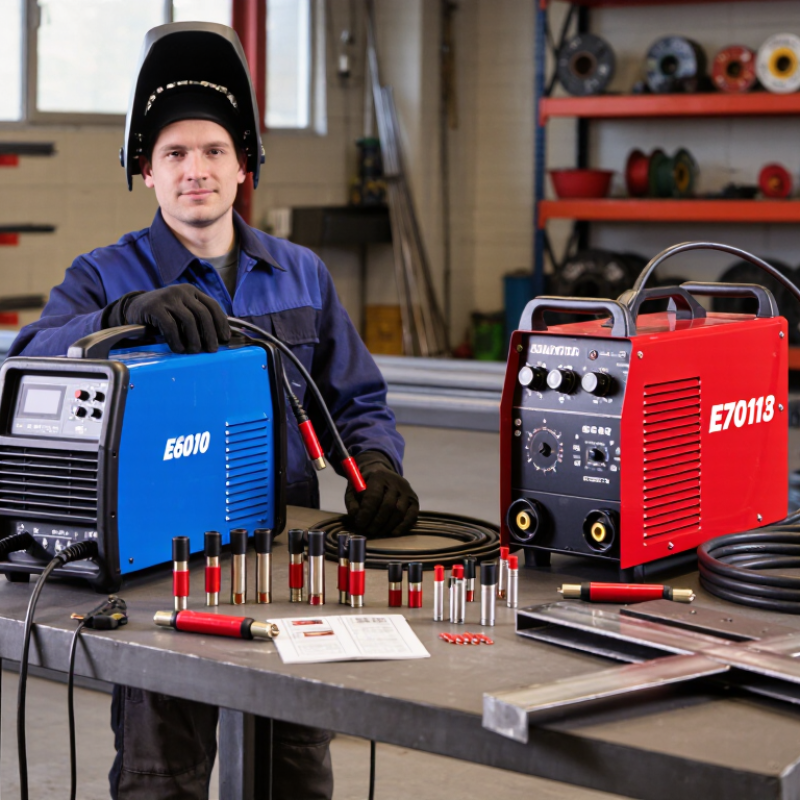
| Portability | Machine weight, carrying handle, cable storage, and suitability for field work. | Typically 4–8 kg; easy to carry between work areas. | Typically 7–14 kg; portable but less convenient for ladders or remote locations. | Typically 15–30 kg; usually requires a trolley or two-person handling. | Typically 30–80 kg; best suited to a fixed workshop position. |
| Input Power | Available supply, plug type, voltage stability, and generator compatibility. | Usually 120–240 V single-phase; suitable for common household or job-site outlets. | Usually 220–240 V single-phase; requires a properly rated circuit. | Usually 220–240 V or 380–415 V; may require a dedicated circuit. | Commonly 220–240 V or 380–415 V; high current demand at startup. |
| Welding Current Range | Adjustability for electrode sizes and material thicknesses. | Approximately 20–160 A; suitable for 1.6–3.2 mm electrodes. | Approximately 20–200 A; suitable for 1.6–4.0 mm electrodes. | Approximately 30–300 A; suitable for 2.5–5.0 mm electrodes. | Approximately 40–300 A; suitable for demanding workshop applications. |
| Control Type | Accuracy, readability, adjustment method, and resistance to dust or impact. | Digital display with rotary adjustment; compact and generally easy to set. | Digital or calibrated dial control; good balance of precision and simplicity. | Large digital display and protected control panel; designed for frequent adjustment. | Mechanical dial; simple and durable but usually less precise to read. |
| Useful Arc Functions | Features that improve starting, arc stability, and electrode release. | Hot start, arc-force control, and anti-stick are commonly available. | Hot start and anti-stick are common; adjustable arc force is preferred. | Hot start, adjustable arc force, anti-stick, and lift-arc functions may be available. | Generally relies on transformer characteristics; fewer electronic arc-assistance functions. |
| Duty Cycle | Continuous welding capacity at a specified current and ambient temperature. | Often about 20–35% at maximum output; adequate for repair and intermittent work. | Often about 30–60% at maximum output; suitable for regular fabrication. | Often about 60–100% at rated output; better for production and long welds. | Commonly about 20–50% at maximum output; varies with transformer size and cooling. |
| Cooling System | Fan size, airflow design, thermal protection, and ease of cleaning. | Compact forced-air cooling; should include automatic thermal cutout. | Forced-air cooling with thermal protection; accessible vents are useful. | High-capacity fan and large heat sinks; designed for extended operation. | Natural or forced-air cooling; large transformers dissipate substantial heat. |
| Safety Features | Protection against overheating, overcurrent, low voltage, and accidental contact. | Thermal overload protection, overcurrent protection, and insulated terminals are essential. | Thermal protection, surge tolerance, cooling-fan control, and clear warning indicators are recommended. | Thermal, overcurrent, overvoltage, and under-voltage protection are strongly preferred. | Thermal protection and properly grounded metal housing are essential; electronic protection is limited. |
| Enclosure Protection | Resistance to dust, moisture, impact, and job-site contamination. | Look for reinforced housing, protected vents, and an enclosure rated around IP21 or higher. | Look for a strong metal or impact-resistant enclosure and dust-resistant ventilation. | Prefer a reinforced steel enclosure, protected controls, and sealed or shielded electronics. | Heavy steel housing offers good impact resistance but may have open ventilation paths. |
| Durability | Construction quality, component protection, cable connections, and serviceability. | Best for light-to-medium use when kept clean and transported carefully. | Good general-purpose durability for workshops and maintenance teams. | Best suited to continuous professional use and demanding fabrication environments. | Mechanically robust with long service potential, but heavier and less efficient. |
| Energy Efficiency | Power consumption, idle draw, and generator fuel efficiency. | High efficiency, commonly around 80–90% under rated load. | High efficiency, commonly around 80–90% under rated load. | Typically around 85–92% under rated load, depending on design and output. | Typically lower, often around 50–75% under rated load. |
| Best Use Case | Match the machine to the expected workload and working environment. | Home repairs, mobile maintenance, light fabrication, and occasional welding. | General fabrication, farm maintenance, installation work, and regular repairs. | Structural work, production welding, thick steel, and extended duty cycles. | Fixed workshop use where weight, energy use, and electronic controls are less important. |
| Overall Suitability | Balanced assessment based on portability, controls, safety, and durability. | Best for mobility | Best all-purpose balance | Best for heavy workloads | Best for simple, stationary operation |